Blogs - What Makes Malaysia Ideally the Safest Choice for Study Abroad?
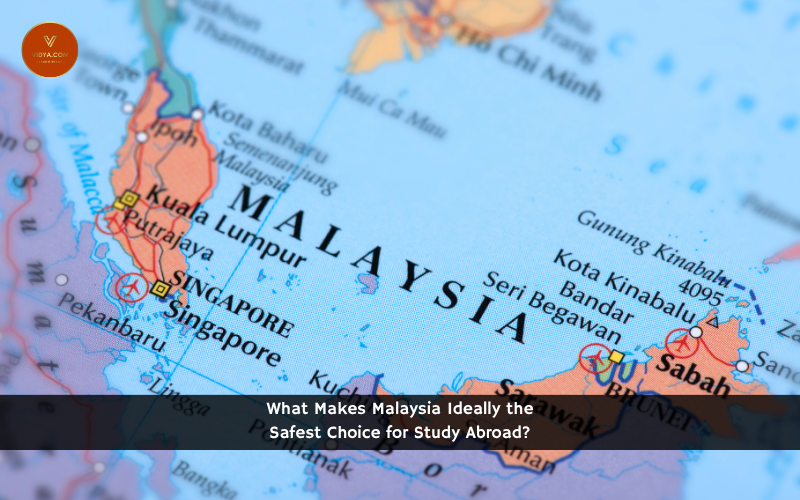
What Makes Malaysia Ideally the Safest Choice for Study Abroad?
Table of Contents
Picture this. You've
shortlisted your dream study abroad destination. You've researched
universities, calculated costs, and imagined your future. Then, breaking news
flashes across your screen. Another geopolitical conflict. Another visa policy
reversal. Another worried phone call from your parents asking, "Is it
still safe?"
This is the reality
thousands of Indian students face today. Choosing a study abroad
destination is no longer just about rankings and return on investment. It is
about choosing a country where your education, safety, and future are all
simultaneously protected.
Malaysia answers every one of those concerns with quiet confidence.
It is peaceful, academically credible, culturally familiar, and genuinely
affordable. It gives Indian students the international experience they
deserve without throwing them into geopolitically volatile environments.
This guide breaks
down every reason why study in Malaysia for Indian students makes
complete sense right now. From safety rankings to career outcomes, every
section is packed with information that will help you and your family make a
smarter, safer, and more confident decision.
Global
Tensions Are Redefining Study Abroad Priorities
The rules of studying
abroad have changed. And they changed fast. Not too long ago, Indian families
evaluated study abroad options based on three things: university ranking,
tuition cost, and job prospects. Safety was an afterthought. Today, it is often
the first question on every parent's list. The ongoing Iran-Israel-US conflict,
rising social instability in parts of Europe and North America, and
increasingly unpredictable visa policies have completely shifted the priorities
of Indian students considering studying abroad.
Study abroad during
global tension is a genuinely complex decision.
Students cannot afford to pick a destination that might face sudden policy
reversals, civil unrest, or deteriorating safety conditions mid-semester. Visa
cancellations, travel bans, and campus shutdowns are no longer theoretical fears.
They have happened in real time to real students.
Traditional Western
destinations, which once dominated study abroad conversations, are now facing
serious scrutiny. Anti-immigrant rhetoric in certain political climates,
tightening work visa rules, and social discrimination concerns have made
families hesitant. The emotional and financial cost of an
interrupted education is enormous.
Malaysia has emerged as a powerful answer to this problem. It is a
stable, democratic, and peaceful Asian nation that has consistently maintained
internal order regardless of global turbulence. Students who choose Malaysia
continue their education uninterrupted. Their academic calendars stay intact.
Their daily lives remain safe and predictable.
For Indian
students who want global education without global risk, Malaysia as a
safe study abroad destination offers exactly the stability that today's
environment demands. The decision to look east rather than west is no longer a
compromise. It is a calculated, intelligent choice.
Malaysia's
Peace Ranking and Political Stability Advantage
Malaysia does not
just feel peaceful. It is measurably peaceful, and the data backs that up. According
to the Global Peace Index 2024, Malaysia ranks among the top 25% most
peaceful countries in the world, consistently outperforming several popular
Western study destinations. This is not a minor statistic. It directly reflects
the country's ability to maintain internal order, manage external pressures,
and protect the daily lives of both citizens and international residents.
Malaysia's political
structure, though diverse and multi-party, has maintained remarkable governance
continuity. Policies affecting international students, including visa
regulations, tuition frameworks, and residential requirements, have remained
largely stable and predictable over the years. Students enrolling today can
reasonably project what their academic journey will look like over the next two
to four years without fearing sudden disruptions.
This Malaysia
student safety advantage is deeply connected to political consistency.
Countries that experience frequent political turmoil often see ripple effects
in education: university funding cuts, campus security issues, administrative
breakdowns, and policy confusion. Malaysia avoids all of these. The government
actively supports international student enrollment because education is a
significant contributor to the national economy.
For Indian
families evaluating safest countries for Indian students, Malaysia's
peace ranking combined with its governance stability creates a compelling case
that goes far beyond surface-level reassurance. It is a destination where
structural safety is woven into national policy, not just promised on a
university brochure.
Peaceful study
destinations in Asia are genuinely rare
at this level of academic quality. Malaysia stands in a category of its own,
offering geopolitical calm alongside internationally respected academic
institutions.
Safety
Systems That Support International Students Daily
Malaysia does not
rely on good intentions to keep students safe. It relies on systems. And those
systems work. The country operates a well-coordinated national emergency
response infrastructure. A single emergency number connects callers to police,
fire, and medical services simultaneously, ensuring fast and efficient
responses to any crisis. Public safety technology, including surveillance
systems in urban areas, public transport hubs, and university campuses,
provides consistent monitoring and rapid incident response.
Malaysia student
safety is also institutionally reinforced at
the university level. Most Malaysian universities have dedicated international
student offices that serve as first points of contact for any safety, legal, or
administrative concern. These offices coordinate with local law enforcement,
immigration departments, and healthcare providers to ensure international
students are never left navigating emergencies alone.
Campus environments
are structured with safety in mind. Dormitories use controlled access systems.
Campus security personnel operate around the clock. Well-lit walkways, clear
emergency exit signage, and regular safety drills are standard features of
Malaysian university campuses. Students living off-campus also benefit from structured
accommodation approval systems that universities use to vet residential options
for international students.
Healthcare access is
another critical safety pillar. Malaysia's healthcare infrastructure is
well-developed and internationally recognized. International students enrolled
in Malaysian universities are required to maintain health insurance coverage,
and most universities facilitate affordable group insurance plans. Medical
consultation fees are significantly lower than in Western countries, making
healthcare genuinely accessible rather than financially frightening.
For Indian
students who are stepping out of their home country for the first time,
knowing that safety systems are functional, accessible, and responsive makes an
enormous psychological difference. Safety is not assumed in Malaysia. It is
actively delivered through real systems that students interact with every day.
Low
Crime, Friendly Society, and Peaceful Living Environment
Malaysia's social
environment is one of its most underappreciated strengths as a study
destination. The country maintains consistently low crime rates compared
to many other popular international education destinations. Violent crime
involving international students is rare, and the government treats any safety
incident involving foreign nationals with high priority. This sends a clear
message: international students are valued, protected, and welcomed.
Beyond the
statistics, Malaysia's social fabric is genuinely warm and accommodating.
Malaysians are widely known for their hospitality, helpfulness, and easy
friendliness with foreigners. For Indian students arriving in a new country for
the first time, this social warmth significantly eases the adjustment process.
You are unlikely to feel invisible, unwelcome, or deliberately excluded.
Peaceful study
destinations in Asia like Malaysia create
an environment where students focus their energy on academics and personal
growth rather than managing stress caused by hostile social environments. This
matters enormously for academic performance. Students who feel safe and socially
comfortable consistently perform better academically than those who are
constantly navigating social anxiety or personal security concerns.
Public spaces in
Malaysia, including shopping areas, parks, public transport systems, and
recreational zones, are well-maintained and family-friendly. Students can
explore their city, commute to university, and engage socially without the
undercurrent of fear that students in higher-crime destinations often describe.
For Indian parents
who worry about their children living independently for the first time,
Malaysia's combination of low crime rates, a genuinely friendly
population, and well-monitored public spaces provides a level of reassurance
that very few study destinations can genuinely claim. Malaysia's student safety
record is not just a statistic. It is a lived, daily reality that students
experience from their very first week on campus.
Strategic
Location and Distance Advantage for Indian Students
Geography matters
more than most people admit in study abroad decisions. Malaysia sits just a few
hours from major Indian cities by air. Direct flights from cities like Chennai,
Mumbai, Delhi, and Kolkata connect to Kuala Lumpur in under five hours. This
proximity is not just convenient. During times of global uncertainty, it is
genuinely reassuring for both students and their families. If an emergency
arises, getting home quickly is possible, practical, and affordable.
This strategic
location also means that time zone differences between India and Malaysia
are minimal, just two and a half hours. Students can maintain regular contact
with family without needing to stay up until midnight for a phone call. This
ongoing emotional connection to home significantly reduces the homesickness and
psychological pressure that many students experience during their first year
abroad.
Being located in
Southeast Asia also gives Malaysian university students exceptional access to a
broader regional network of opportunities. Internships, academic exchanges, and
professional networking events across the ASEAN region become accessible in
ways that students studying in distant Western countries simply cannot
replicate. This regional advantage has direct career implications, particularly
for students interested in industries like finance, technology, trade, and
logistics that are rapidly growing across Southeast Asia.
For Indian
families prioritizing both safety and accessibility, the geographical
proximity of Malaysia is a practical advantage that compounds over time.
Emergency accessibility, emotional connectivity, and regional career
opportunities all flow from this single geographical reality. In the calculus
of safe study abroad destinations for Indian students, proximity is a
variable that deserves far more weight than it typically receives.
Academic
Excellence with Global Recognition at Lower Risk
Let's settle this
question directly: Does studying in Malaysia compromise academic quality?
Absolutely not. Over 20 Malaysian universities feature in global ranking
systems, demonstrating genuine academic credibility on the world stage. Several
of these institutions have established branch campuses of globally renowned
universities, allowing students to earn internationally recognized degrees from
within Malaysia. This means students can receive a degree from a reputable
global institution without physically relocating to a higher-risk country.
Malaysia university
admission process standards are rigorous and internationally
aligned. Programs are offered across engineering, business, medicine,
information technology, social sciences, and the arts. English is widely used
as the medium of instruction, which removes the language barrier that often
complicates studying in non-English-speaking countries.
Affordable study
abroad in Asia reaches a compelling peak in Malaysia.
Annual tuition fees at Malaysian universities typically range from 3 to 10 lakh
rupees, depending on the program and institution type. This represents a significant
cost saving compared to studying in the United States, United Kingdom, or
Australia, where equivalent programs can cost three to five times more.
Malaysia vs USA study comparisons consistently reveal that Malaysian degrees in
engineering, business, and technology are well-recognized by global employers,
particularly across Asian markets that are driving the majority of global
economic growth. Students who graduate from Malaysian universities enter job
markets in India, Southeast Asia, and beyond with degrees that carry real
professional weight.
For students seeking high
ROI international education without entering geopolitically volatile
regions, Malaysia delivers academic credentials that are competitive,
recognized, and financially sensible. This is not settling for the second best.
This is making a strategically superior choice.
Structured
Learning and Principal-Led Academic Mentorship
Malaysia's academic
culture is disciplined, structured, and genuinely supportive of international
students. Principal-led mentorship is a meaningful feature of the
Malaysian university experience. Academic leaders and faculty members take
active roles in guiding student progress, not just through formal instruction
but through advisory systems that monitor performance, flag concerns early, and
provide structured intervention when students need support. This academic
mentorship Malaysia framework ensures that no student falls through the
cracks simply because they are far from home and unfamiliar with the system.
Faculty-led learning
systems in Malaysian universities are built
around consistent engagement. Attendance is tracked, assignments follow
structured deadlines, and academic performance reviews happen at regular
intervals throughout the semester. This mirrors the disciplined academic
environment many Indian students are already familiar with from school and
competitive exam preparation, making the academic transition smoother than
expected.
Structured university
education in Malaysia also includes peer
mentorship programs, where senior international students help newcomers
navigate campus life, administrative processes, and social integration. This
layered mentorship ecosystem, combining faculty guidance with peer support,
creates an environment where international students adapt quickly and perform
consistently.
For Indian
students who thrive under structured academic systems with clear
expectations and regular feedback, Malaysian universities offer exactly that.
The combination of faculty-led learning systems, disciplined academic
monitoring, and genuine academic mentorship Malaysia creates a
foundation for consistent progress that is hard to replicate in more loosely
structured academic environments.
Structured university
education is not just an academic benefit. It is
a safety net for students who might otherwise feel overwhelmed by the
independence and ambiguity of studying abroad for the first time.
Transparent
Admissions and Predictable Entry Requirements
One of the most
stressful parts of studying abroad is not knowing where you stand in the
admission process. Malaysia eliminates that stress. Transparent admission
criteria are a defining feature of Malaysia university admission process
standards. Universities publish clear eligibility requirements, documentation
checklists, and evaluation criteria that students can access and verify
independently. There are no hidden expectations, no ambiguous
"holistic" reviews, and no last-minute surprises. What you see in the
admission requirements is what gets evaluated.
Merit-based admission
Asia principles govern most Malaysian
university programs. Academic performance, standardized test scores, and
documented achievements are the primary evaluation criteria. This encourages
diligence and preparation, which is exactly how the majority of Indian
students are taught to approach academic competition from a young age.
Transparent admission
criteria also enable consultants and students
to make accurate, realistic assessments of admission probability before
investing significant time and money in the application process. Students know
from the outset whether they are competitive for their chosen program, which
allows for smarter program selection and better use of application resources.
Compared to some
Western systems where subjective factors can introduce significant uncertainty,
Malaysian university admissions are refreshingly clear. Documentation
requirements are standardized. Application timelines are published well in
advance. Scholarship criteria are explicitly stated rather than vaguely
suggested. This predictability reduces anxiety, improves preparation quality,
and ultimately leads to better outcomes for students who prepare methodically.
For Indian
families who appreciate clarity and fairness in the evaluation process,
Malaysia's transparent admission criteria and merit-based admission
Asia philosophy create a foundation of trust that makes the entire study
abroad decision feel more manageable and less risky.
Multicultural
Comfort with Strong Indian Presence
Here is something
that genuinely matters but rarely appears in official university brochures:
feeling at home. Malaysia has one of the largest Indian diaspora communities in
Asia. Approximately 7% of Malaysia's population is of Indian origin, with a
significant Tamil-speaking community that has maintained strong cultural ties
over generations. This means Indian students arriving in Malaysia for
the first time are not stepping into a completely unfamiliar cultural
environment. They are stepping into a country that already understands,
appreciates, and celebrates Indian culture.
Practical daily
comforts follow naturally from this cultural presence. Indian restaurants
serving authentic regional cuisines are widely available across Malaysian
cities. Hindu temples, Indian grocery stores, and cultural festivals are part
of the mainstream Malaysian social landscape. Students who observe dietary
restrictions, including vegetarianism or specific religious food requirements,
will find Malaysia far more accommodating than most Western study destinations.
Tamil and Hindi are
understood in many parts of the country, and while English is the primary
academic language, the presence of Indian cultural familiarity significantly
reduces the social adjustment burden that often affects international students
during their first few months abroad.
Study in Malaysia for
Indian students also offers the dual advantage of
cultural comfort and genuine multicultural exposure. Malaysia's diverse
society, which includes Malay, Chinese, Indian, and international communities,
gives students meaningful cross-cultural experience that builds the global
competence employers increasingly value. Students graduate with both academic
credentials and genuine intercultural communication skills.
For Indian parents
worried about their children struggling with culture shock or social isolation,
Malaysia's multicultural environment offers reassurance that is grounded in
demographic reality rather than optimistic marketing.
Cost
Advantage and High Return on Investment
Let's talk about
numbers because they tell a compelling story. Affordable study abroad in Asia
finds one of its strongest expressions in Malaysia. The average annual tuition
fee for undergraduate programs at Malaysian universities ranges from
approximately 3 to 8 lakh rupees. Postgraduate programs are comparably
affordable, ranging from 4 to 12 lakh rupees annually. These figures represent
significant savings compared to equivalent programs in the United States,
United Kingdom, or Australia, where the same programs can cost anywhere from 20
to 50 lakh rupees per year.
Living costs in
Malaysia are equally reasonable. A student can live comfortably, including
accommodation, food, transport, and leisure, on a monthly budget of
approximately 25,000 to 40,000 rupees. This is dramatically lower than the
monthly living expenses in cities like London, Sydney, or New York, where even
basic student living often exceeds 1 lakh rupees per month.
High ROI
international education becomes genuinely
achievable in Malaysia because the input costs are controlled while the output
in terms of career access, degree recognition, and professional networks
remains globally competitive. Students graduate with internationally recognized
qualifications and significantly lower debt loads than their counterparts who
studied in Western countries.
Part-time work
regulations in Malaysia allow international students to work up to 20 hours per
week during term time, providing opportunities to gain practical experience and
offset living costs simultaneously. Post-study employment pathways within
Malaysia and across the ASEAN region are growing steadily, giving graduates
real options for building their careers regionally before returning to India.
For families
comparing Malaysia vs USA study purely on financial grounds, the return
on investment calculation strongly favors Malaysia. Lower costs, comparable
academic quality, and strong regional career access create an equation that is
genuinely difficult to argue against.
Role
of an IIM Alumna Education Consultant
Choosing a study
abroad destination during global uncertainty is not a decision that benefits
from guesswork. An IIM alumna education consultant brings a level of
analytical rigor and strategic thinking to education counseling that
fundamentally changes the quality of decisions students and families make. The
same frameworks used in business strategy and management consulting are applied
to student profile evaluation, university selection, and application planning.
The result is structured, data-backed guidance rather than commission-driven
recommendations.
Trusted overseas
education guidance from an IIM
alumna education consultant in India helps families evaluate destinations
not just on academic rankings but also on genuine safety parameters, visa
predictability, career outcomes, and cultural compatibility. Malaysia
consistently scores strongly across all these dimensions, and a qualified
consultant can explain exactly why with evidence and data rather than
promotional material.
NUS admission processes and other competitive Asian university
applications require detailed knowledge of documentation requirements,
application timelines, and eligibility criteria. An experienced consultant
ensures students present their profiles in the strongest possible way while
targeting programs and institutions that genuinely match their academic
background and career goals.
For first-generation
international students from India who have no family framework for
understanding how overseas admissions work, an IIM alumna education
consultant becomes an essential guide through what can otherwise feel like
an opaque and overwhelming process. The consultant provides clarity, reduces
anxiety, and significantly improves outcomes at every stage of the journey from
initial profile assessment to final enrollment.
Expert trusted
overseas education guidance also means that students are steered away from
destinations that carry genuine risks whether political, social, or financial
and toward countries like Malaysia that offer documented stability and proven
academic value. This kind of informed, safety-first guidance is exactly what
today's global environment demands.
Malaysia
as a Safe, Smart, and Future-Focused Choice
Every argument in
this guide points toward the same conclusion. Malaysia is not a backup option.
It is a genuinely strategic choice. Safe study abroad destinations for
Indian students need to satisfy multiple criteria simultaneously: political
stability, low crime, cultural comfort, academic quality, and strong career
outcomes. Very few destinations satisfy all five criteria at once. Malaysia
does, consistently and measurably.
Students who choose
Malaysia make a decision that their families can support with confidence, their
future employers will respect, and their own long-term well-being will benefit
from. The combination of affordable study abroad in Asia, transparent
admission criteria, structured university education, and genuine
multicultural comfort creates an academic experience that is both personally
enriching and professionally rewarding.
As global tensions
continue to reshape study abroad decisions, Malaysia's positioning as a peaceful
study destination in Asia only becomes stronger. More Indian students are
recognizing this reality every year. Enrollment of Indian students in Malaysian
universities has grown steadily over the past five years, a trend that reflects
informed decision-making rather than convenience.
High ROI
international education in a safe, stable,
and culturally supportive environment is not an idealistic wish. In Malaysia,
it is a documented, repeatable outcome. Students who choose Malaysia today are
making the kind of forward-thinking, evidence-based decision that delivers
benefits for years after graduation.
Conclusion
Malaysia has built a
convincing, data-backed case as one of the smartest safe study abroad
destinations for Indian students in today's uncertain global environment. From
its strong peace rankings and low-crime environment to its affordable tuition,
globally recognized degrees, and deeply multicultural society, every dimension
of the Malaysian study experience is designed to support student success safely
and sustainably.
Indian students who choose Malaysia are not settling for less. They are
choosing more: more safety, more cultural comfort, more financial practicality,
and more career relevance in a rapidly growing Asian economic region.
The combination of principal-led
mentorship, transparent admission criteria, structured learning
environments, and the expert guidance of an IIM alumna education consultant
creates a complete framework for making study abroad decisions that are
confident, informed, and genuinely future-ready.
Malaysia is safe.
Malaysia is smart. And right now, for Indian students navigating global
uncertainty, Malaysia is quite simply the right choice.
Frequently
Asked Questions (FAQs)
1. Why is Malaysia
considered one of the safest countries for Indian students studying abroad?
Malaysia consistently
ranks among the top 25% most peaceful countries globally according to the
Global Peace Index. It maintains low crime rates, stable governance, advanced
emergency response systems, and strong institutional support for international
students. Its significant Indian diaspora community also ensures cultural
familiarity, making it one of the most genuinely safe study abroad destinations
for Indian students available today.
2. How does the
Malaysia university admission process compare to Western university admissions?
Malaysia university
admission process standards are built on transparent admission criteria and
merit-based admission principles. Unlike some Western systems that rely on
subjective holistic reviews, Malaysian universities evaluate applicants on
clearly defined academic benchmarks, standardized documentation, and academic
performance records. This predictability gives Indian students a clear,
manageable pathway to admission without subjective uncertainty.
3. Is studying in
Malaysia genuinely affordable, and what is the return on investment?
Yes, affordable study
abroad in Asia reaches one of its strongest expressions in Malaysia. Annual
tuition fees range from approximately 3 to 12 lakh rupees depending on the
program, which is significantly lower than equivalent programs in Western
countries. Combined with moderate living costs, part-time work opportunities,
and strong regional career access, Malaysia delivers exceptional high ROI
international education without requiring students to accumulate excessive
financial debt.
4. How does an IIM
alumna education consultant help students choose Malaysia as a study
destination?
An IIM alumna
education consultant in India provides structured profile evaluation,
university shortlisting, and application planning based on safety parameters,
academic fit, and career outcomes. Trusted overseas education guidance from a
credentialed consultant ensures students make informed decisions backed by data
rather than promotional material, steering them toward stable and career-ready
destinations like Malaysia while avoiding geopolitically risky regions.
5. How does
Malaysia's multicultural environment benefit Indian students specifically?
Malaysia has a
well-established Indian diaspora comprising approximately 7% of the national
population. Indian students can access authentic Indian cuisine, cultural
festivals, Hindu temples, and Tamil-speaking communities across major Malaysian
cities. This cultural familiarity significantly reduces adaptation stress,
allowing students to focus on academics from their very first semester. At the
same time, Malaysia's diverse multicultural environment builds the
intercultural competence that global employers increasingly value in graduates.